
Updated
What hard water stains are — and why Omaha has them worse than most cities
Free hard water assessment. Request online and we'll tell you whether your stains are removable before we charge anything.
Why Omaha has a hard water problem
Omaha's tap water comes primarily from the Missouri River, treated and distributed by Metropolitan Utilities District (MUD). As the Missouri flows from Montana down through the Great Plains, it picks up dissolved minerals from limestone bedrock and ancient sedimentary deposits. By the time it reaches Omaha, the water carries a mineral load that measures at roughly 14.2 grains per gallon — equivalent to about 243 parts per million (ppm) of calcium carbonate.
For context:
| Classification | Grains per gallon | Ppm |
|---|---|---|
| Soft | 0–1 | 0–17 |
| Slightly hard | 1–3.5 | 17–60 |
| Moderately hard | 3.5–7 | 60–120 |
| Hard | 7–10.5 | 120–180 |
| Very hard | 10.5+ | 180+ |
| Omaha | ~14.2 | ~243 |
Omaha sits firmly in "very hard" territory — well past the threshold where mineral deposits become visible on glass within weeks, not months. That hardness shows up everywhere — on shower doors, faucets, fixtures, dishes — but windows are where it's most visible and most damaging, because:
- Sunlight accelerates the mineral-glass bond
- Sprinklers hit the same panes repeatedly, building layered deposits
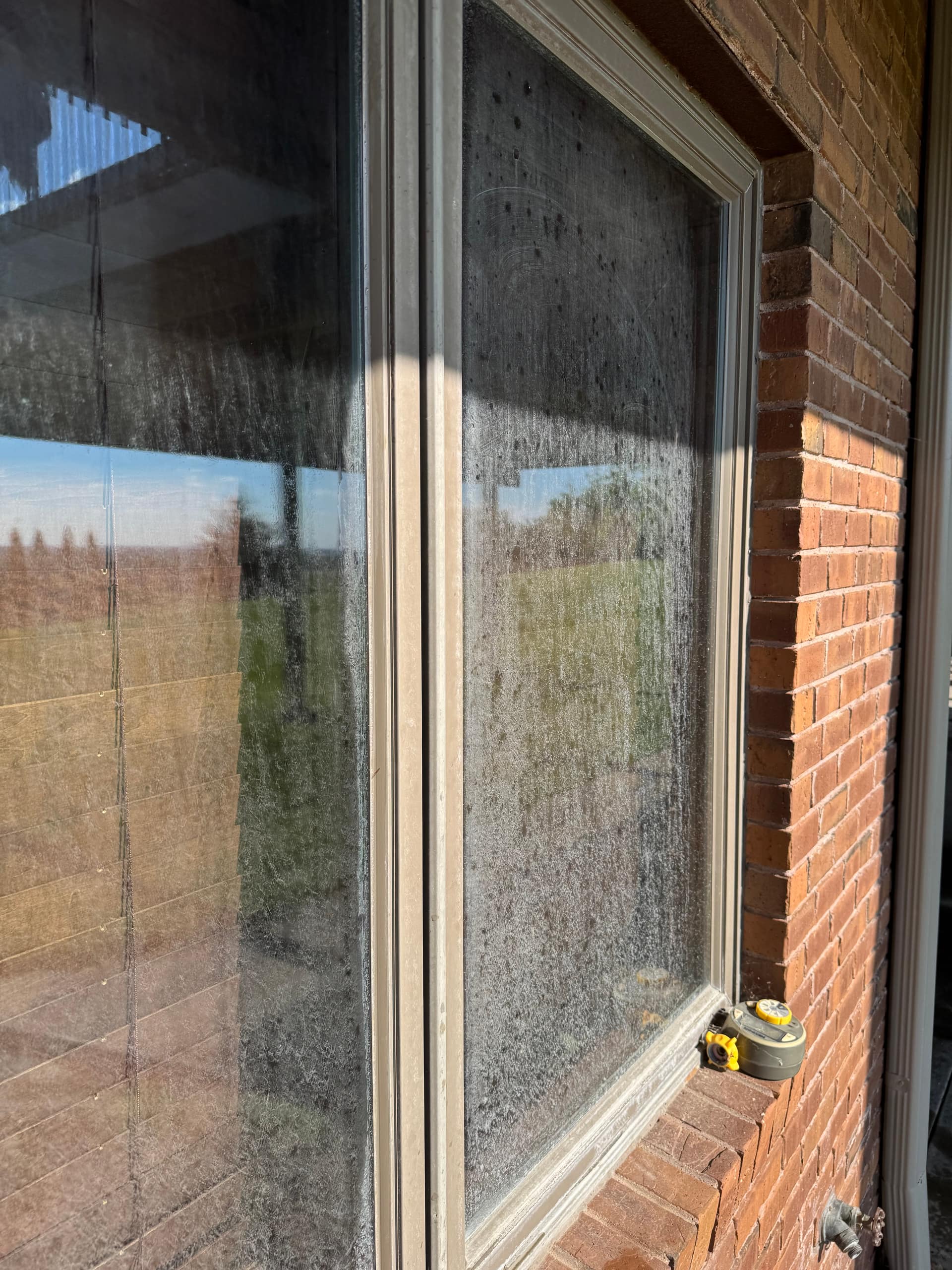
- Glass is smooth, so dried minerals leave geometric spots, rings, and films you can see at any angle
- Untreated, the minerals eventually etch into the glass surface, becoming permanent
How to tell if your windows have hard water stains (vs. ordinary dirt)
| Sign | Hard water | Ordinary dirt |
|---|---|---|
| Spots are circular or ring-shaped | ✓ | Less common |
| Won't wipe off with glass cleaner | ✓ | Wipes off easily |
| Concentrated near sprinklers or roof runoff | ✓ | Usually random |
| White or cloudy haze | ✓ | Brown/gray |
| Appears after rain | ✓ | Less seasonal |
| Worse on south- and west-facing windows | ✓ | Even distribution |
Common sources of hard water on Omaha windows
- Lawn sprinklers — by far #1. West Omaha, Elkhorn, and Bennington homes with newer irrigation are the most affected.
- Roof runoff — gutters that overflow or downspouts that splash off concrete onto window glass.
- Pressure washing splashback — if your siding was pressure-washed and the windows weren't squeegeed afterward.
- Window AC condensation — drips from window AC units leave mineral lines down the lower window.
- Pool / hot tub spray — pool water also has high calcium hardness.
- Hose down spray — washing cars or patios with the same hose that hits windows from below.
Are hard water stains permanent? (Etched vs. removable)
| Stage | Description | Removable? | Treatment |
|---|---|---|---|
| Surface deposit | Fresh minerals sitting on top of glass | Yes — easily | Acid-based cleaner |
| Bonded deposit | Minerals chemically bonded after weeks of sun | Yes — with work | Glass restoration polish |
| Lightly etched | Glass surface starting to pit | Mostly | Cerium oxide polishing |
| Heavily etched | Glass deeply pitted | No | Glass replacement |
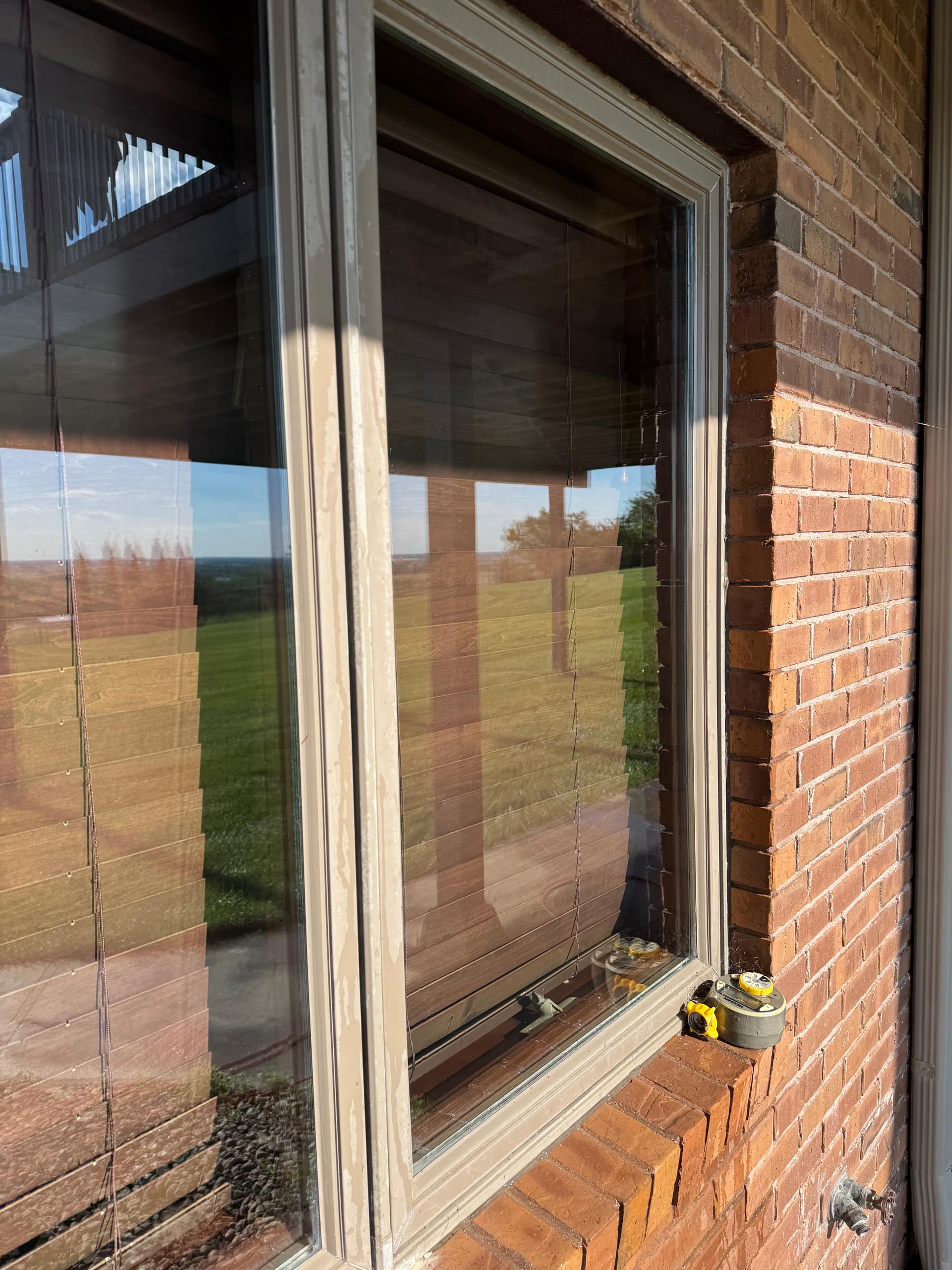
The vast majority of Omaha homes we see (probably 90%+) fall into the first two categories. Etching becomes permanent at roughly 18–36 months of untreated sun exposure.
Our hard water stain removal process
- Free assessment. We test a small section with a mild restoration product. If it lifts, the rest will lift.
- Protective prep. Mask off frames, cover sills, lay drop cloths.
- Chemical treatment. Apply restoration product, work in with non-scratch pads, rinse with purified water.
- Final polish + protect. Optional polymer sealant that makes future spots wipe off easily for 6–9 months.
We do NOT use:
- Steel wool or abrasive pads on standard windows
- Hydrofluoric acid (dangerous + illegal in most residential settings)
- Razor blades on tinted, coated, or new glass
How we price hard water work
We don't quote a flat number for hard-water removal — every job starts with a free on-site assessment, because the right price depends on three things we can't see from a form: how long the deposits have been bonding, how many elevations of the home are affected, and whether the glass has started to etch (which is a different job entirely).
What the assessment tells you, in plain English:
- Whether your stains are still removable or have crossed into permanent etching
- The severity tier (light surface deposits, bonded deposits, or full-restoration work)
- The exact price for your home before we touch a window
- Whether a polymer sealant after the job is worth it for your sprinkler situation
No charge for the assessment, no obligation to book. If the deposits are too far gone for restoration, we'll tell you that too — and point you toward glass replacement instead of taking work we can't finish well.
For the rest of our service pricing — residential, commercial, screens, tracks, and the recurring plans — see our pricing page.
Service areas — where we see the worst hard water problems
- West Omaha — the #1 hard-water problem area we see.
- Elkhorn — new construction + new irrigation.
- Bennington — same story, newer.
- Champions Run, Linden Estates, Indian Creek, Eagle Run, Pacific Springs — high-end HOAs with extensive irrigation.
We also serve Papillion, Bellevue, Gretna, La Vista, Millard, and Council Bluffs IA.